Showing posts with label Travel. Show all posts

Saturday, August 1, 2015

A Short Trip to Hong Kong

So, I thought I'd take a break from talking about job hustling, and share a little about a recent short family trip to Hong Kong.

Hong Kong is the the place beyond Singapore that I most frequently visit. It's mainly because of familial ties: my father is a born-and-bred Hong Konger (he is a Singapore citizen now) and his parents still live there. We visit my grandparents about once every year or two years.

You'd think that I'd be super familiar with Hong Kong after countless visits, but nope, I am afraid I only know just a tad more than your average tourist. I can't even speak fluent Cantonese, just a few random words and phrases. Still, I consider Hong Kong a second home of sorts, given my blood ties to the city and the fact that I am a Hong Kong PR. I always looks forward to every visit to Hong Kong and hope to do a work stint there someday.

This year's trip was a pretty short one but we still managed to have loads of fun! Like Singapore, Hong Kong is a modern and highly urbanized city with tall buildings everywhere. Its CBD is also situated by the sea:

The ferry terminal near Hong Kong station.

Despite being really modern, there are still pockets of rusticity within Hong Kong. We visited the little village of Tai O, located in Lantau Island, for the first time. It is a stark contrast to the bustling metropolis that comes to mind when people normally think of Hong Kong:

The little village of Tai O, AKA Venice of the East. Reminds me more of Penang, actually.
There's not much to do in tiny little Tai O, except strolling along the sea, exploring the rustic neighborhood, visiting the markets and eating delicious street food. A particularly popular street food stall in Tai O, and one that I definitely recommend, is this place run by a cool dude in shades who makes Hong Kong style egg waffles over a charcoal stove:

Most shops in Hong Kong make egg waffles with an electric grill pan. This dude does it the old school way!

Speaking of food! Every time we visit Hong Kong, my family and I always have fun trying all kinds of delicious Hong Kong food. My ideal traditional Hong Kong breakfast is either dim sum with my family, or a bowl of Hong-Kong style Congee and Zha Liang (dough fritters wrapped in rice sheet) on the side:

I love Zha Liang! This delicious Zha Liang is sold at a popular Congee shop in the Fortress Hill neighborhood called Congee Wonderland.

For lunch or dinner, I recommend a bowl of Prawn Wanton Noodles at Mak Siu Kee (Traditional) Wonton Noodle. They have several outlets in various parts of Hong Kong, but we have only tried the Fortress Hill outlet. This is their specialty Prawn Wonton Noodle:
On this trip, I learnt that one of the special ingredients used to make the Prawn Wonton Noodles savory is dried prawn roe.

Finally, if it is desserts that you crave, pop in one of the several Hui Lau Shan outlets all over Hong Kong! Hui Lau Shan specializes in desserts made using fruits (particularly mangoes):

Beat the hot and humid Hong Kong summer with cold fruity desserts! 

Hong Kong will always have a special place in my heart (and stomach :P). I thought I had seen most of it already. but Dad said that we have not covered some of the small islands as well as the New Territories area yet. Excellent, plenty to look forward to for the next trip!

Image credit: All photos were taken by me.

Sunday, August 18, 2013

The Fifth Trip to Japan: Some Tips for Traveling Free and Easy around the Land of the Rising Sun

Back in December 2012, I wrote a long and detailed post about my fourth holiday in Japan (see here), and ended the post with "Japan will always be one of my favourite countries to visit. Sayonara, for now, I will surely be back again to visit when I can!".

Well, to think that "when I can" turned out to be only about 5 months later! This time, it wasn't just for the purpose of holiday, but for participating in a conference on human development held a week ago in Hiroshima. I was one of the selected poster presenters and my father himself signed up to do a presentation. Much as I'd love to, we couldn't stay very long in Japan as Dad needed to return to work, so we were there for only about 4 days.

The conference turned out to be a memorable and fun experience for me. It was my very first time presenting my academic work (my Honours thesis, actually) to other academics. I was quite nervous initially about how others would receive my work but was pleasantly surprised by the larger-than-expected crowd that gathered at my poster. It was quite fun fielding questions and a few participants even told me that my topic was an interesting one! Not bad at all, for my very first presentation (and an overseas one at that)!

Anyway, having visited Japan five times already (and looking forward to any subsequent visits), I thought I'd share some tips about travelling around Japan. Here, my main focus will be on travelling around Hiroshima prefecture as I just returned from this region so everything is still pretty fresh in my head. Dad and I had 2 full days to unwind and explore Hiroshima prefecture after the conference. Having visited Hiroshima prefecture with Mum last year, I was already fairly familiar with this area so I was able to travel independently with Dad to places I visited before as well as some other new places I did not get to visit last year. One of the things I like about travelling in Japan is that it is not difficult. Also, there is so much to eat, see and explore along the way!

Use Public Transport

The Hiroden arriving at Hakushima station, which is the district our hotel was located in.

In Hiroshima city, a very popular mode of public transport is the Hiroden, the streetcar that has been in use for decades. I like the Hiroden as it is punctual, regular, takes me to many of the main places of interest and inexpensive. Using the Hiroden is also easy to figure out. The streetcar map provides a really good bilingual visual guide of where each place of interest and district is located, as well as which streetcar routes to take to get there. Boarding the streetcar is a simple matter of hopping on and then paying the fare to the driver when you get off (how much you pay is easily worked out by referring to the streetcar map, or you can look at the signboard above the driver's seat which tells you how much you need to pay when alighting at various destinations).

Outside of Hiroshima, I recall that getting around Kyoto was pretty easy too. In Kyoto, the public buses have announcements in English, Japanese, Mandarin and Korean to tell you the current stop and the next one, as well as the current location of the bus displayed on an electronic route map.

Take the Trains

A bento I had on the shinkansen ride to Narita airport. This bento is special because it features specialty food from various towns within Hiroshima prefecture.

The Shinkansen arriving at Hiroshima train station. Dad and I took the Shinkansen to Narita International Airport the day we left.

Japan has an excellent and reliable train network. The trains connect not just the major cities, but a great many smaller cities and towns in the rural areas as well.

For those travelling independently to many Japanese towns and cities, I strongly recommend buying a JR Pass. The JR Pass allows you to bulk buy 7 days or 14 days worth of travel within Japan and therefore saves you a great deal of money if you travel on your own a lot.

Dad and I did not get a JR Pass for this trip as it was only 4 days. Yet, I do feel a little that it would have been good to get one anyway because we travelled by train to several cities within Hiroshima prefecture and a JR Pass might have helped save a bit of travel expenses.

Language and Communication

In Miyajima, where the famous Itsukushima shrine is located, bilingual signs are common as many international visitors come to visit. This Kakigori (Japanese shaved ice dessert) shop offers about 30 different syrups to go with your cup of shaved ice and has bilingual signs to explain each flavour (Tomato, Sea Salt and Hibiscus flavours, anyone?).


Based on my familiarity with travelling around Japan, I do find that it helps to know some Japanese for interacting with the locals. Not speaking Japanese at all is much less of a problem in big cities like Tokyo or popular tourist spots where bilingual signs are more common and more residents can speak English. However, in the smaller towns and in the countryside, people tend to be able to speak only basic English or not at all. Hiroshima is the capital of Hiroshima prefecture and a fairly big city but in general the locals I've interacted with speak limited English.

My Japanese is basic, in that I am able to recognize and read hiragana, katakana and some kanji. I can also hold a simple conversation in Japanese. Limited though it may be, I found that knowing some Japanese helped a great deal. This is especially so when reading menus. Outside of Tokyo and other major cities, English menus are hard to come by. Being able to understand terms written in hiragana and katakana, coupled with my own ability to read Mandarin and therefore recognize many Kanji characters, was very useful in reading menus written entirely in Japanese and offering no pictures.

Having said that, don't be put off from communicating with the Japanese if you can't speak Japanese. Many Japanese are willing to help in spite of the language barriers. Japanese customer service is truly of a high standard as commonly perceived, so even when there are difficulties in communication, with patience and lots of hand gesturing, things often work out very nicely in the end.


Eat local food!

I've said this in my Japan 2012 post, and I'll say it again: the easiest and most fun way to immerse oneself in local culture is to eat local food. You're in a very enviable position if you find yourself in Japan because different towns and prefectures have their own local specialties, some of them unusual and very delicious! To know what to eat where, one should do some research before visiting. Many towns and prefectures take great pride in their local specialties and emphasize them in order to draw tourists. For example, Hiroshima is famous in Japan for it's Hiroshima-style Okonomiyaki, Oysters and its signature candy souvenir is Momiji Manju (a Maple leaf shaped cake that traditionally contains a red bean paste filling but nowadays has all sorts of fillings put into it). When I stayed in Hiroshima last week, I also found out that Hiroshima prefecture is also famous for its Lemons as well, so Dad and I bought some boxes of Lemon candy souvenirs in addition to the Momiji Manju packages.

If you travel by train a lot, then an easy and inexpensive way to sample some local specialties is to buy a bento box from the train station and eat it on the train. In the Hiroshima prefecture-themed bento box featured earlier, there was a good variety of little bites of foods special to the region: jelly made of local Lemons, deep-fried local Oyster, local Octopus cooked in rice, Sushi topped with local Sardines and my favourite Conger Eel Sushi. So. Good. I enjoyed my bento so much that I saved the pretty bento box cover that was still clean and it now hangs proudly in my bedroom.


Inside the gorgeous Hiroshima prefecture-themed bento. It's not just pretty to look at, more importantly, it is delicious too!


Eating Hiroshima Okonomiyaki at Rei-chan, a Hiroshima Okonomiyaki eatery located on the second floor of the ASSE department store near Hiroshima train station. Sorry to all my friends in the Kansai region, but I actually prefer the Hiroshima-style Okonomiyaki to the more well-known Osaka one.


Of all the local delicacies I've eaten during my travels to Japan, I think Anago Meshi (broiled Conger Eel on rice), a specialty of Miyajima, is my favourite. I enjoyed it so much while in Miyajima last year that I had to eat it again when I visited Miyajima this year. This bowl of Anago Meshi is from Ueno, a famous restaurant specializing in Conger Eel near Miyajima train station that has been around for decades. One word: heavenly. The perfect end to a visit to Miyajima.


The Most Important Travel Tip: Have an Open Mind!

I'll end this post with what I find is the most important travel tip based on my experiences travelling to many countries around the world: be open-minded and humble enough to learn.

Being open-minded means not having an ethnocentric attitude towards the new culture and society. You will just end up alienating yourself and not enjoy your trip. Instead, take the opportunity of being in a new environment to expand your horizons. It's also fun to do as the locals do! Japan was experiencing a heat wave when Dad and I visited last week but we made the best out of the situation by taking the opportunity to follow some of the popular local ways to beat the heat, such as ordering a cup of kakigori (Japanese shaved ice dessert) and eating it on the go.

Being open-minded also means having a willingness to go off the beaten track and explore by oneself. As I've described in this blog post, Japan is not difficult to explore free and easy, which is good news for someone like me who dislikes tours, as I find that tour guides tend to rush their groups from one destination to other or bring them to random places along the way so they can earn some extra commission. On our own, Dad and I could take our time exploring the places we visit and therefore appreciate them more, as well as discover some hidden gems along the way!

After exploring the beautiful seaside town of Onomichi on foot in the blazing summer heat, stumbling upon a café specializing in cold desserts like Sakura Tea House is like stumbling upon an oasis in a dessert! The desserts are excellent too!


Japan is a country that I've been to 5 times already and I'm keen to visit again and again. When you treat each new visit as an adventure and as a chance to learn (and relearn), then each visit will be memorable and enjoyable in its own unique way.

Monday, December 31, 2012

Japan Trip 2012


(2012 is coming to an end soon, but before it does, I want to conclude this very eventful and memorable year with a reflection on my last big adventure of the year. This is a long post because there is so much to be said, but then I'm mainly writing this for myself, in line with this blog's stated aim of preserving as best as I can those unique moments in space and time of my life. May 2013 be just as eventful, fulfilling and memorable as 2012!)


I visited Japan for the fourth time in my life this month. You’d think I’d be bored of Japan having visited several times before, but when my mother first proposed that she and I travel together to Japan for a 15 day holiday during my summer break, I readily and happily agreed. Japan is one of my favourite countries in the world so I’m always keen to visit every now and then.

I shall not give a detailed description of what I did and where I went for each and every day of my trip. That’ll be too long, and besides, that’s not the point of this blog entry. No, I want to talk about why I find Japan alluring enough to visit again and again, drawing mainly from my most recent adventures in Japan.

For my fourth trip, Mum and I covered 5 main places: we started in Kyoto, then went West to Hiroshima, back to the Kansai region to stay in Koyasan, followed by an Eastwards journey to Takayama and finally ending in Tokyo. Most of our time was in the Kansai region (where Koyasan and Kyoto are located).

Religion

Kinkakuji
Nightime illumination at Kodaiji
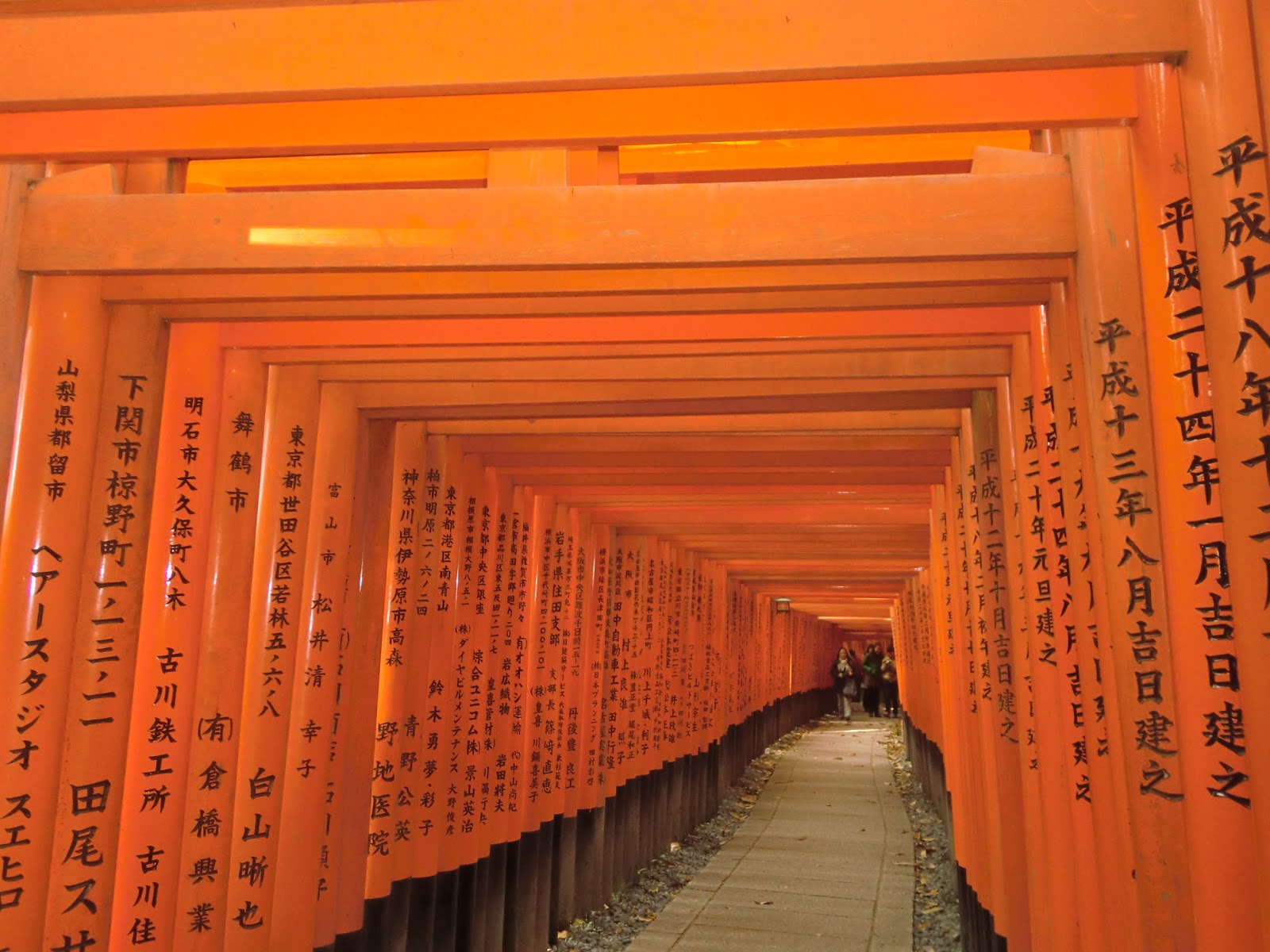
Rows and rows of toriis at Fushimi Inari Taisha, my favourite shrine among all that I have visited
Beautiful and intricate designs of the shrine in Fushimi Inari Taisha
Votive tablets at the Fushimi Inari Taisha

The famous torii outside the Itsukushima Shrine, in Miyajima
This trip to Japan was a pilgrimage of sorts. Mum and I visited many temples and shrines mainly while we were staying in the Kansai and Chugoku regions. My family isn't really religious; on census forms we usually declare ourselves free - thinkers. However, we do practice some Buddhism, such making a point to pray or burn incense at many of the shrines we visit. The main religion in Japan is Shinto, but we still visit and pray at many Shinto shrines in Japan since Shinto and Buddism in Japan overlap substantially. I enjoy these visits very much because I find the rituals to be followed fascinating: first the washing up done at the purification fountains, then stepping from the realm of the profane into the sacred space of the shrine grounds, clasping my hands in prayer before the deity (sometimes bowing, clapping and ringing a bell as well) and silently articulating my hopes and dreams. The visits sometimes conclude with buying some amulets or shrines at the shrine shops. Next semester being a very important one for me, I bought a few to guide me as I continue to chase my dreams in the year ahead.
The highlight of our "pilgrimage" was our three day two night stay in Koyasan, a sacred mountain in Wakayama prefecture, Kansai region. We lodged at a lovely Buddhist temple during our visit, which was a first time for both of us. We enjoyed very much the peacefulness of the rural and rather difficult to access Koyasan village our temple was located in, as well as the peacefulness of our temple itself (we came during off - peak season so there were very few other guests). A thoroughly unforgetable Zen experience!

Food

Yudofu at Sosoan, a restaurant specializing in soy and tofu located near the Philosopher's Path. Kyoto is known for its excellent tofu.
An array of stewed goodies at the famous Nishiki market in Kyoto. This colourful and vibrant market is a foodie's paradise, and one of my favourite places visited.
Green tea desserts at the cafe of the famous Nakamura Tokichi, a green tea merchant and confectionist based in Uji. Uji, located outside Kyoto, is famous in Japan for its premium quality green tea.
This is one of my favourite meals this trip, called anago meshi (broiled conger eel on rice), a specialty of Miyajima. Anago meshi can be eaten piping hot straight from the kitchen or room temperature in a bento, but I prefer the former.
Maple leaf shaped deep - fried fish cakes sold near Itsukushima Shrine, Miyajima. The maple leaf motif is pretty common in the Hiroshima Prefecture.
Another favourite meal, shojin ryori at the temple we stayed in Koyasan. Shojin Ryori is a Buddhist vegetarian cuisine, but while it may be entirely meat free, it is really pretty, delicious and healthy!
Breakfast at the lovely temple in Koyasan we stayed in, shojin ryori style.
Breakfast with grilled hoba miso (on leaf) on the side, in Takayama. Hoba miso is a specialty of the Takayama region, and it is so good with rice and grilled fish!
Hot - of - the - grill Mitarashi Dango is a popular street snack in Takayama.
The prettiest (and most expensive bento) I consumed this trip, eaten along the train journey from Takayama to Tokyo. It was a very well - balanced meal with great variety, but the only fault was that the brown rice on the bottom right corner was a little too salty. On the whole, though, it was a pleasant meal.
Awazenzai (red bean paste with millet), a specialty dessert from Umezono, a popular dessert shop near the Sensoji Temple in Asakusa, Tokyo. I still don't know what those peppery tasting seeds in the little blue container is, but it helps to cut through the richness of the awa and zenzai mixture! Perfect!


 I believe that the easiest (and possibly the most fun way) to immerse oneself into a new culture is to have a taste of the local cuisine. Japanese cuisine is popular worldwide and I'm a big fan myself. Some may argue that Japanese food is bland compared to other cuisines such as Indian and Thai with their bold flavours, but the beauty of Japanese food is precisely this keeping of flavours simple. Often, with just a little of the right seasoning, the Japanese can make the flavours of meat, vegetables and seafood shine. Less is certainly more. Other reasons why I like Japanese food is that it is (generally) healthy and the presentation is often beautiful even for takeaway bentos at the train station.
 This trip to Japan, I decided to go beyond the familiar Japanese foods such as teriyaki, katsudon and karaage and focus more on regional specialities. Most of the food featured above are therefore unfamiliar to many including myself before I arrived in Japan. It was great fun eating my way around Japan! Markets are some of my favourite places as they offer an array of delicious street food that can be eaten on the go or plates of food to sample as one explores. Some regional foods I didn't like much, such as Onomichi  - style ramen, which came with cubes of lard on top on the soup noodles ( talk about a heart attack waiting to happen!). My Mum and I also found Takayama - style ramen too simple as compared to more famous ramen varieties such as Hakata's Tonkotsu ramen and Hokkaido's miso ramen (which is our favourite ramen of all). Nevertheless, the fun was really in trying out as much as you can, and discovering what you liked and didn't like so it didn't matter that some dishes failed to impress. My favourite cuisines this trip come from the Kansai region, specifically Kyoto, the regions surrounding Kyoto and Koyasan. Simple yet elegant and delicious, they capture the essence of Japanese cusine so well.

 Nature

Beautiful autumn leaves in Uji


Wild purple flowers in Inari

A rainbow appeared over the snowy mountains in Shirakawa - go

An aerial view of Mt Fuji, seen while flying back home to Singapore from Japan


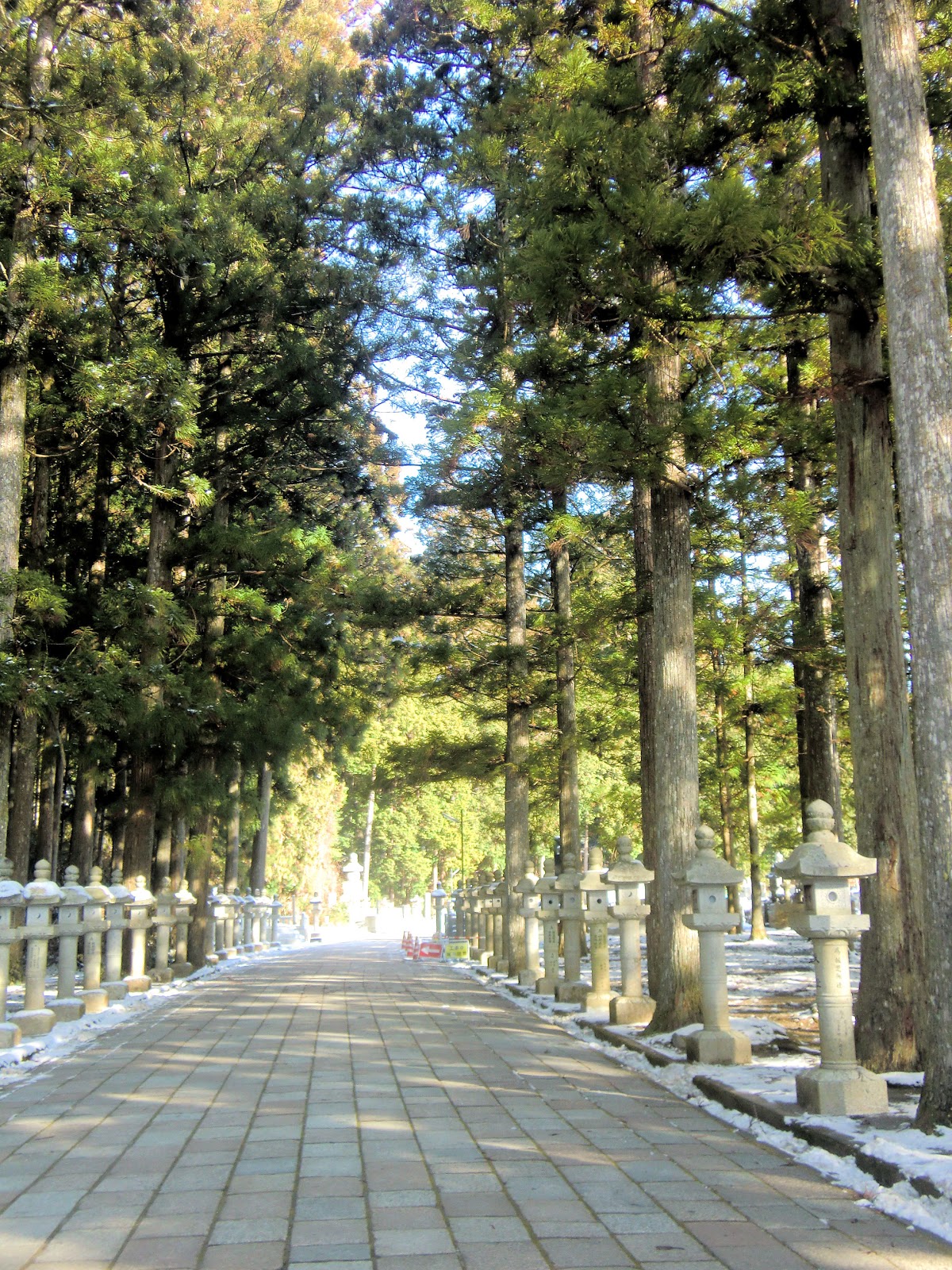
The road to Okunoin in Koyasan, lined with tall trees (Cedar, I think)
Anyone ever noticed that many Japanese surnames and place names reflect nature? E.g. The 'yama' (mountain) in Yamamoto and Okayama, 'kawa' (river) in Kawasaki and Shirakawa - go, 'matsu' (pine tree) in Matsumoto, 'mizu' (water) in Mizuno, 'aki' (autumn) in Akihabara and Akiko and many more. The importance of nature is related to the significant role the Shinto religion/ spirituality plays in Japanese culture, as Shinto emphasizes respect of nature.
I was therefore unsurprised to observe that the Japanese appreciate nature more than many other cultures do. Why else would they travel just to see the cherry blossoms bloom in Spring and the maple leaves change colour in Autumn? I, too, enjoy revelling in the beauty of nature. One of my best memories from this trip is the walk through the huge cemetery outside Okunoin in Koyasan, weaving our way through graves, memorials, small shrines and towering ancient trees. Melting snow from the leaves and branches above dripped gently upon us like a shower of rain, and shimmered in the sunlight that pierced through the canopy. So beautiful, so Zen.

(Pop) Culture

Hyouka poster commonly seen around Takayama, the town this anime was based on. I liked this poster so much I went around asking many people where I could buy it, and was directed to the strangest of places (folk art gallery? pharmacist?). In the end, it turned out that this was an official tourism poster not available for sale, so I made do with purchasing another really nice Hyouka poster at a toy shop. I've now been inspired to watch the Hyouka anime!

Giant anime ads at Akihanara, Tokyo, the mecca of electronic gadgets and all things anime and manga!


Little boy playing with the water pump at the Ghibli Musuem, Mitaka, Tokyo


 When one thinks of Japanese culture, pop culture usually comes to mind. Japanese pop culture, particularly anime and manga, are very popular worldwide. Being a big fan myself, I always make it a point to stop by any shop I come across specializing in anime and manga merchandise whenever I come to Japan because of the sheer variety many of these shops offer. And if I happen to be in Tokyo, a short visit to Akihabara, that mecca of all things Japanese pop culture, is mandatory.

For this month's trip, I finally made my "pilgrimage" to the Ghibli Musuem in Mitaka, Tokyo! This museum has got to be one of my favourite musuems I ever visited. It has the same magical feel you get from watching the beautiful Ghibli films. Mum and I arrived on a weekday morning before 10am, thinking that it wouldn't be very crowded because it was, well, a weekday morning before 10am. How wrong we were. When we finally arrived at the musuem, there was a massive crowd waiting to enter, consisting mainly of international visitors like ourselves and locals. That crowd was a testament to the immense popularity of Ghibli films, which evidently cut across age and national boundaries. We all entered the musuem full of excitement, were collectively wowed by the very well - thought exhibitions (pity, though, that all the explanations were in Japanese!) and left with bags of lovely Ghibli souvenirs.

 Conclusion on My Experiences in Japan

One of my favourite pictures taken this trip - a man selling Battledores at the year - end Hagoita - Ichi fair at Sensoji Temple, Asakusa, Tokyo.

Rural mountain villages and bustling big cities. Traditional sho - tengai markets and glitzy malls. A pilgrimage of sorts to various temples and shrines and a pilgrimage of a different kind to the Ghibli museum. Not to mention eating my way through a diversity of regional Japanese cuisines. This may be my fourth trip to Japan, but never once did I feel bored, for there is a huge wealth of experiences to discover and rediscover in Japan.
Japan is definietly beautiful in the many ways I have described earlier, but what made all my trips to Japan truly beautiful was the hospitality and kindness of the local people. Truth to be told, before I arrived, I was a little worried about being discriminated in Japan. Japan is notorious for being an insular country where a clear distinction is made between locals and foreigners, so I was mentally prepared that people would not waste too much time on foreigners like myself. How wrong I was! There have been many occsaions of locals trying their best to help when approached, and service staff offering excellent service to the point of going the extra mile. I felt truly welcomed in Japan. At the end of my trip I realized that a meaningful and positive cross - cultural encounter is when both parties approach each other with an open - mind. For the part of tourists, it helps immensely to show that one is genuinely interestested and curious about the local culture. My own spoken Japanese is basic but I found that simply trying to speak the local language and being interested worked wonderfully well to break down barriers. "Doko kara kimashita  ka (Where are you from)?" " Shingapooru kara kimashita! (I'm from Singapore!)" "Aa, Shingapooru... (Ah! Singapore...)" Smiles are exchanged and a mutual understanding is reached.
Japan in the international news is usually not so positive: frequent changing of prime ministers, rapidly aging population, the aftermath of last year's earthquake and tsunami, gender inequality etc. All these are no doubt very real, but I never got such a depressing sense whenever I visited, simply because there was so much beauty around me to discover and rediscover. Japan will always be one of my favourite countries to visit. Sayonara, for now, I will surely be back again to visit when I can!